An uncontested divorce in BC may be decided on written materials. Registry staff can screen a desk-order package for filing defects, but the court decides whether to grant the divorce. Incomplete materials can delay the decision.
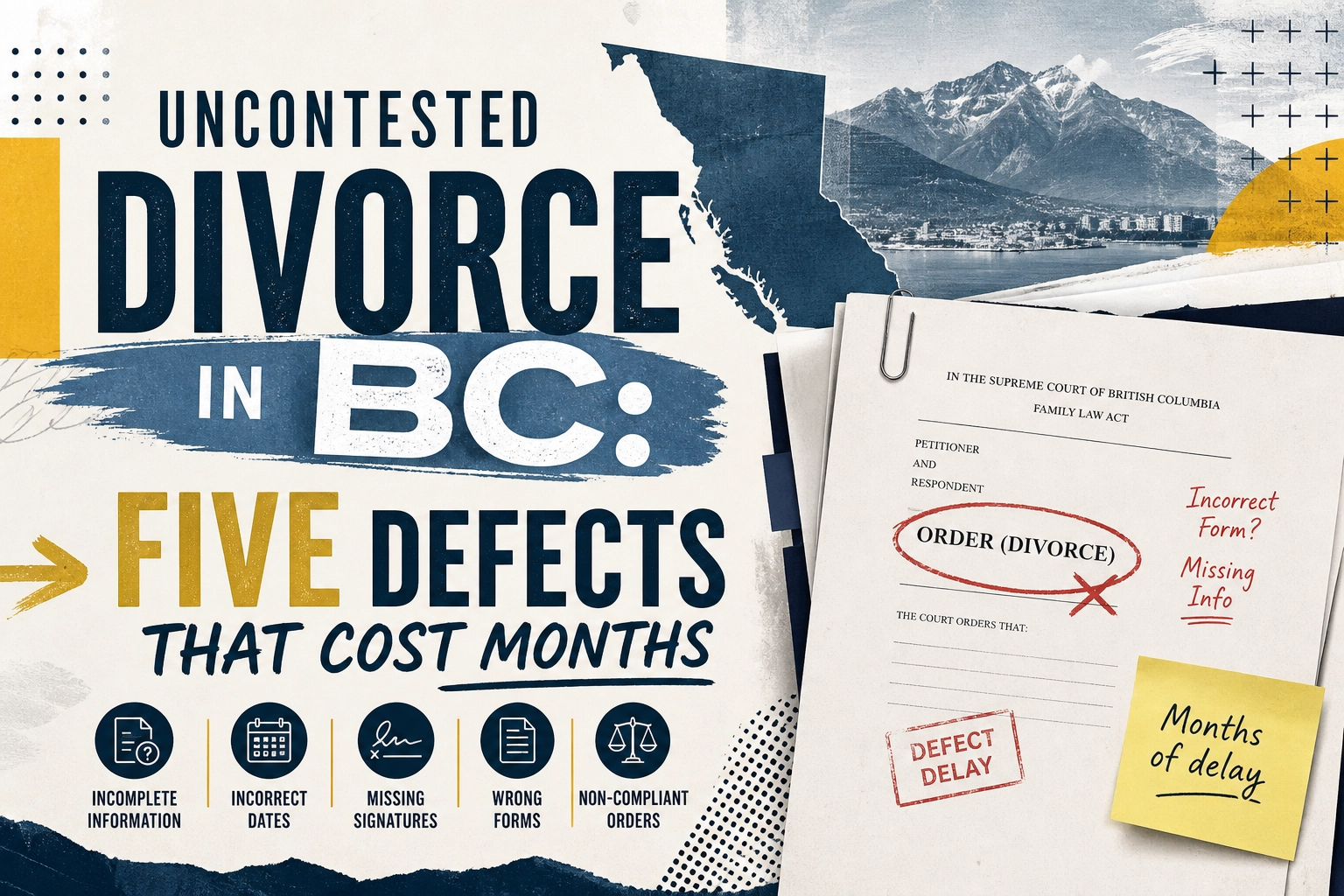
This guide is for beginners who want a clear view of the process. It explains why an uncontested divorce in BC is not a paperwork formality, what a registrar actually checks in a desk order file, and then walks through five defects: an affidavit of service the registry cannot accept, the wrong form sequence for a joint or sole application, corollary relief claimed in language the order cannot grant, thin evidence on child support and the section 11 gate, and unsigned, undated, or unsworn supporting documents. It closes with a pre-filing checklist and a practical takeaway: check the file before the registrar does.
Why Uncontested Divorce in BC Is Not a Paperwork Formality
An uncontested divorce in BC is one in which the divorce claim is not opposed. An undefended case can often be decided on written materials without a hearing. If other claims remain contested, do not assume the divorce can go through by desk order: ask whether a separate divorce order is available and what procedure applies.
If you rely on one year of separation, you and your spouse must already be living separate and apart when the divorce proceeding starts, but you do not have to wait a full year to file. The year must be complete before the court determines the divorce. At least one spouse must have been habitually resident in BC for the year immediately before the proceeding began. Adultery and cruelty are separate ways of establishing marriage breakdown under the Divorce Act.
Registry processing times vary. A divorce generally takes effect on the 31st day after judgment, subject to exceptions under section 12 of the Divorce Act. If the registry returns your package for correction, that can add time.
Five recurring defects cause many desk-order returns, and every one is checkable before the package leaves your desk.
What a Registrar Actually Checks in a Desk Order File
Once your package reaches the registry, the filed notice of family claim and its supporting material are reviewed on paper against the Supreme Court Family Rules, with court staff and then a judge going through the package. There is no courtroom appearance; the decision is made on the written material.
Registry staff can check filing requirements, but the court decides whether the evidence supports the orders sought. Check the current forms, proof of service, the relief pleaded and, for a divorce, the evidence addressing child support and collusion.
The gap that catches people is that the rules set the requirement, while registry practice governs how that requirement has to appear on the page. A file can meet the rule and still fail the practice.
General warnings about wrong forms or omitted evidence do not say which step or what evidence causes trouble. That vagueness is why another walkthrough of the process adds little. A defect-by-defect check before filing is what keeps a file out of the return pile.
Defect 1: An Affidavit of Service the Registry Cannot Accept
For a sole undefended application, the court generally needs proof that the filed Notice of Family Claim was served. See Rules 4-1, 6-6 and 10-10 of the Supreme Court Family Rules. Form F15 is the usual proof of personal service and is sworn or affirmed by the person who served the claim. If the court authorized an alternative method, follow that order and prove service accordingly.
Common failures are predictable: the affidavit describes an unfiled copy rather than the version on file; the respondent’s name or address differs from the claim; the date or place is blank; the applicant swears instead of the server; or the method used is not permitted for that document. If personal service could not be achieved, you may need the court's permission to serve another way, so describe the authorised method, not the failed attempts.
If your file came back on service: check that the affidavit names the document served, the date, the place and the person served, and that the jurat is complete.
Keep a dated service log from the day of service: who served, when, where, how, and which document. Draft the affidavit from those notes, not memory months later. Verify Form F15 against the Rules first. If the return also raises wider doubts, changing family lawyers in BC is a separate decision.
Defect 2: The Wrong Form Sequence for a Joint or Sole Application
The form set you file depends on who is applying. In a sole application, one spouse applies against the other, filing the notice of family claim (Form F3), and the file depends on proof of service. In a joint application, both spouses apply together on the notice of joint family claim (Form F1), and each route carries its own forms. Filing one route with the other route's paperwork produces a package the registry cannot enter: the notices, affidavits and order materials the chosen route requires are simply not there.
What changes between the routes is narrow but consequential: which claim form is used, whether a service affidavit is needed at all, whether supporting affidavits are joint or separate, and how the draft order is framed.
If your file came back on forms: compare the form numbers you filed against the current provincial family forms index. Revised versions supersede older ones, and an out-of-date form can hold up the file.
Choose the appropriate joint or sole route at the outset. If a joint case stops being consensual, check Rule 2-2 of the Supreme Court Family Rules. It provides a withdrawal and continuation procedure, so starting a new file is not always necessary.
Defect 3: Corollary Relief Claimed in Language the Order Cannot Grant
Even with the correct form sequence, a draft order can still fail if the corollary relief goes beyond what the claim supports. Corollary relief means the orders that travel with the divorce itself, covering parenting, support and property.
The defect takes several shapes: relief that was never pleaded; a dollar figure the filed evidence does not support; an undefined term the order cannot enforce; or a clause that hands a decision to a third party instead of setting the term. A registrar returns the order rather than repairing it, because it must match the claim and be enforceable as written. A registrar cannot draft relief the parties never asked for.
Support wording needs particular care. Frame it against the Child Support Guidelines and show the basis for the figure rather than leaving a round number.
If your draft order came back: read it paragraph by paragraph against the notice of family claim. Confirm each requested term maps to a pleaded claim before resubmitting. For context on how the order fits the wider file, see this BC divorce process guide.
Defect 4: Thin Evidence on Child Support and the Section 11 Gate
Even properly pleaded support relief can fail in an uncontested divorce in BC if the evidence behind it is thin. The court has to be satisfied that reasonable child support arrangements are in place, measured against the Federal Child Support Guidelines, and that there is no collusion. A divorce can be held back where child support has not been addressed at all.
Thin evidence looks like a bare assertion that support “has been agreed,” no income information for either spouse, no written explanation for a departure from the table amount, and no signed agreement or existing order attached to the file. Collusion is the related risk: the court must see that the parties are genuinely separated and not arranging a result, so the separation date and support terms should align across every document.
If your file came back on support: attach the agreement or calculate the Guidelines amount, explain any deviation in writing, and include income evidence for both spouses rather than a summary sentence. Where parenting terms are also in issue, BC parenting time explained sets out the companion framework.
Defect 5: Unsigned, Undated or Unsworn Supporting Documents
If the support evidence is sound, the final gate is the page itself. A sworn document needs a signature in the correct place and a complete jurat: the commissioner's confirmation that the deponent swore or affirmed the contents, with the place and date recorded. Every exhibit the affidavit references must be marked and attached.
Many failures are simple ones. A jurat with no date. A jurat commissioned before the document was finished. An exhibit named in the text but missing from the package. A fillable PDF signed in a field the registry does not read. The draft order belongs in this check too: correct parties, correct claim number, the terms actually sought, and a signature block the registrar can sign without editing.
If your file came back on a signature: deal with the missing signature or date by having the document properly sworn, and do not alter a document after it has been commissioned.
Before filing or couriering, check the assembled package page by page for signatures, dates and initials. Then have a second person run the same check. The person who drafted the file is the least likely to see the blank line. Those five checks now form the pre-filing checklist.
The Pre-Filing Checklist for an Uncontested Divorce in BC
Every defect above is cheaper to correct before filing than after a return, so run these five checks against the assembled package rather than the plan.
Eligibility. Check habitual residence when the proceeding starts and, for a separation-based divorce, confirm the full year of separation before the court decides the divorce. Resuming cohabitation primarily to reconcile for no more than 90 days in total does not, by itself, interrupt the separation period.
Service. An affidavit of service that meets the registry's requirements, or a substitutional service order on file where personal service was not achievable, describing the method the order actually authorised.
Forms. The joint or sole route chosen once, with every form number checked against the current provincial Supreme Court family forms index rather than an old downloaded set.
Relief. Every term you want in the order pleaded in the claim, the draft order matching the claim line by line, and child support calculated against the Guidelines with the basis documented.
Signatures and dates. Every affidavit sworn with a complete jurat and exhibits attached, and the draft order complete for signature. For the wider sequence these checks sit inside, read our divorce in Vancouver essentials.
With the package checked point by point, the last question is whether the file on the registry's desk says what you intended it to say.
The Takeaway: Check the File Before the Registrar Does
Run the checklist against the assembled package, not against your intention. Every defect here is a mismatch between what was planned and what is on the page: the service date you remember versus the one in the jurat.
If your file came back, treat the return as a diagnosis with a named cause rather than bad luck. Fix that cause, then confirm nothing downstream depended on it. Some corrections are straightforward, but repeating service or swearing documents again costs time.
Get a second read before resubmission. A fresh set of eyes catches what the person closest to the draft does not. If property is in play, building a BC property division file applies the same discipline to the financial side.
For separating spouses in BC who want the package reviewed before it goes to the registry, Outset Law’s Vancouver divorce lawyers can review a desk-order package before you file.
Conclusion
An uncontested divorce in BC is not a paperwork formality. The practical safeguard is the pre-filing checklist, run point by point against the package itself.
Before that package leaves for the registry, Outset Law, a Vancouver-based boutique family law firm handling separation, divorce and court representation, can give the file the second read it needs. Check the file now, so the registrar does not send it back later.

General information only. This article is not legal advice and does not create a lawyer-client relationship. Laws change and every family's situation is different. Speak with a lawyer about your circumstances.